


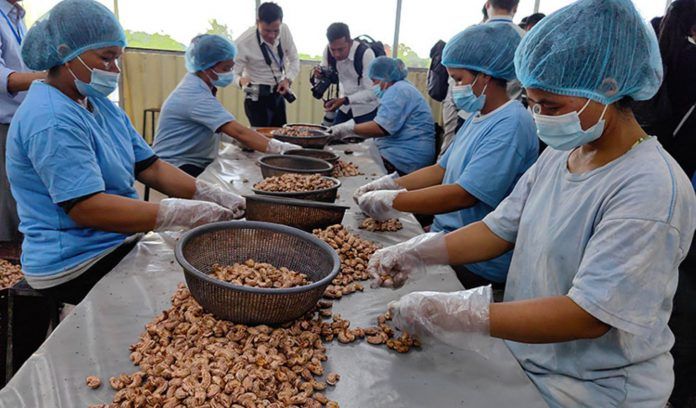
Cambodia aspires to become the “world’s cashew capital” with its “cashew industrial park” project in Kampong Thom.
(July 18, 2025) Cambodia aspires to become the “world’s cashew capital” with a “cashew industrial park” project in Kampong Thom.
The Cambodian Cashew Association (CAC) has been working with foreign investors from China, India, and Singapore to introduce the 400-hectare Cashew Industrial Park (CIP), which is scheduled to officially launch later this year.
CIP is a major initiative of the Royal Government of Cambodia aimed at helping the country become a leading cashew processing and export hub in the region.
“This initiative is designed to attract domestic and foreign investors through a series of incentive policies. Companies operating within the CIP will benefit from preferential tax and customs policies, access to state-backed infrastructure, full ownership of land leased from the government without Cambodian shareholders, long-term land leases at reasonable costs, and many other investment support measures to promote sustainable growth,” the CAC statement said.
These incentives are part of a larger strategy to encourage deep processing and increase value-added in the agricultural sector, helping Cambodia move beyond exporting only raw cashew nuts. The CIP will play a key role in “promoting economic growth, creating jobs, increasing farmers’ incomes and stabilizing agricultural prices,” CAC said.
Cambodia is striving to become a leading player in the global cashew industry, with Kampong Thom as the main processing center. The raw materials for CIP (Cashew Processing Industry) come not only from Kampong Thom, but also from neighboring provinces such as Kratie, Stung Treng, Ratanakiri, Preah Vihear, and Kampong Cham.
Cambodia is currently the world’s second-largest producer of cashew nuts and is expected to soon rise to the top position.
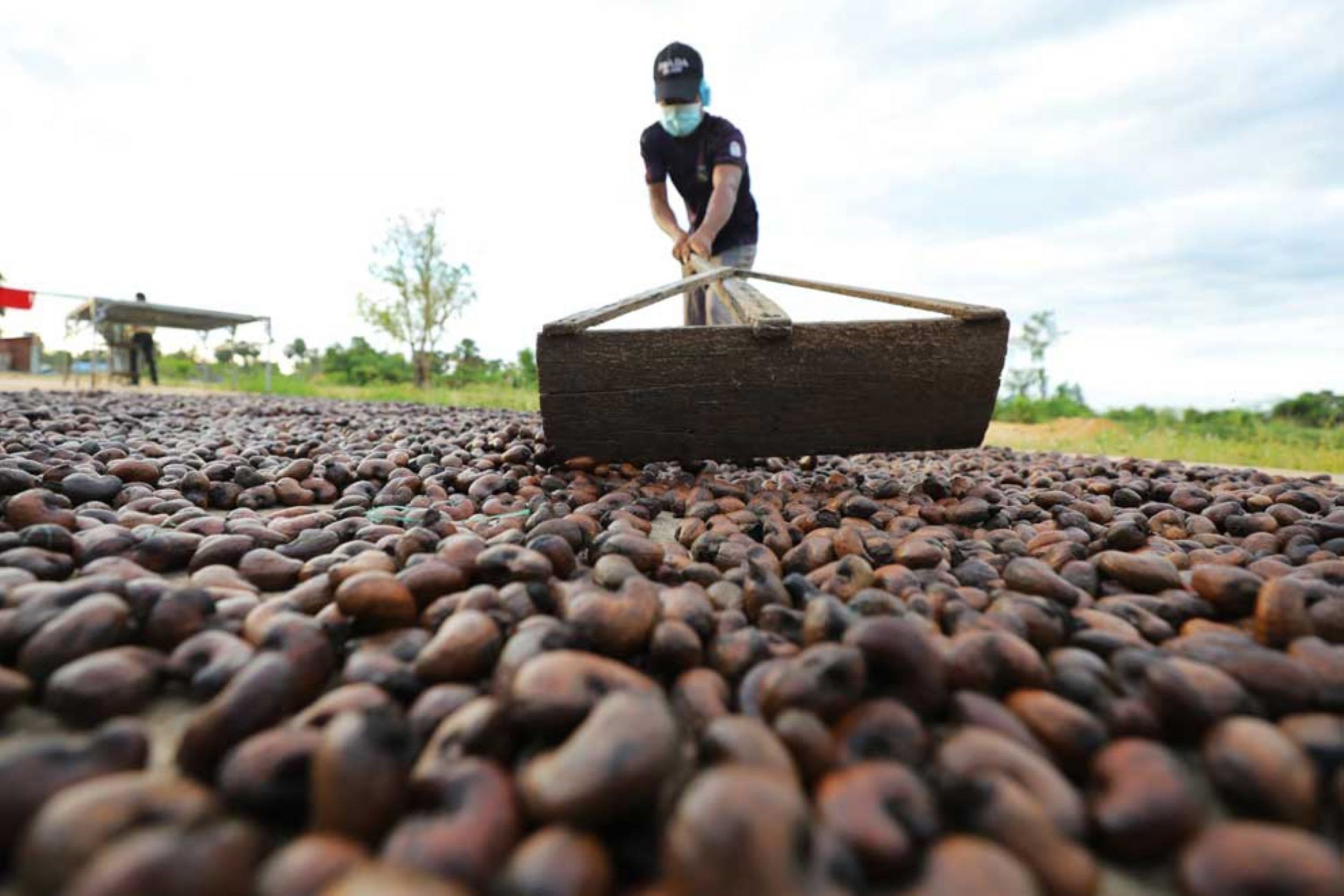
CAC Vice Chairman Suy Kokthean stated that Cambodian cashews are renowned for their high quality, and with the government’s preferential investment policies under the Quality Investment Project (QIP-Plus), investors will reap significant benefits from expanding their operations there. In June 2025, the CAC organized a field trip to Kampong Thom province for Royal Nuts Pte Ltd., headquartered in Singapore. Royal Nuts is expected to launch a pilot project with an annual production of 15,000 tons in 2026, with capacity subsequently increasing to 120,000 tons per year.
According to the Ministry of Agriculture, Forestry and Fisheries (MAFF), Cambodia ranks third in the world in cashew cultivation area, with an estimated 580,117 hectares currently in harvest and 120,000 hectares under new planting. Of this, Kampong Thom province has the largest area at approximately 147,700 hectares, followed by Kratie (102,500 hectares) and Ratanakiri (97,200 hectares). Annual cashew production ranges from 800,000 to 1 million tons. Neighboring Vietnam consumes 90-95% of Cambodia’s cashew production.
Vietnamese businesses prefer importing cashew nuts from Cambodia due to its logistical advantages. A shipment from Cambodia to Vietnam takes only 1-2 days, and the shipping cost is relatively low compared to sea freight costs when importing from other countries, such as Tanzania and Nigeria.
The Vietnam Cashew Association (VINACAS) aims for $4.5 billion in exports this year, an increase of $130 million compared to last year.
According to the General Department of Vietnam Customs, Vietnam spent nearly $2.1 billion importing cashew nuts in the first five months of the year. Cambodia was the largest supplier of cashew nuts to Vietnam with over 873,200 tons, worth $1.32 billion, accounting for 63% of the total imports.
This figure far exceeded the cashew nut import value from Cambodia in 2024 ($1.07 billion) and was only lower than the import value for the whole of 2021 ($1.87 billion). The average import price also increased by 19%, reaching an average of $1,517/ton.
There is a significant discrepancy compared to data from Cambodia. The Cambodian Ministry of Commerce stated that the country exported $753.21 million worth of cashew nuts in the first six months of the year, a 56.67% increase compared to the $480 million figure for the same period last year.
Tanzania was the second largest supplier with over 133,000 tons, valued at over $242 million, representing a 93% increase in volume and a 179% increase in value compared to the same period last year. Prices surged by 45% to $1,822 per ton.
Nigeria ranks third among Vietnam’s cashew nut suppliers with over 69,000 tons, worth more than $106 million, representing a 67% increase in volume and a 138% increase in value. Import prices increased by 42%, reaching $1,533 per ton.
Ricky Ho
Source: BSA Media
- Cambodia aspires to become the “world’s cashew capital” with its “cashew industrial park” project in Kampong Thom.
- Vietnamese cashews: From raw export to opportunities for cashew milk in the US.
- Vietnam’s Cashew exports to China have surpassed $1 billion for the first time.
- Fruit, vegetable exports to China climb to record $5.5B
- Why are Vietnamese cashews considered “the best in the world”?
Related articles:
-
Fruit, vegetable exports to China climb to record $5.5B
-
Why are Vietnamese cashews considered “the best in the world”?
-
Vietnamese cashews: From raw export to opportunities for cashew milk in the US.
-
Vietnam’s Cashew exports to China have surpassed $1 billion for the first time.
-
Vietnam’s Cashew exports exceeded $5 billion for the first time.